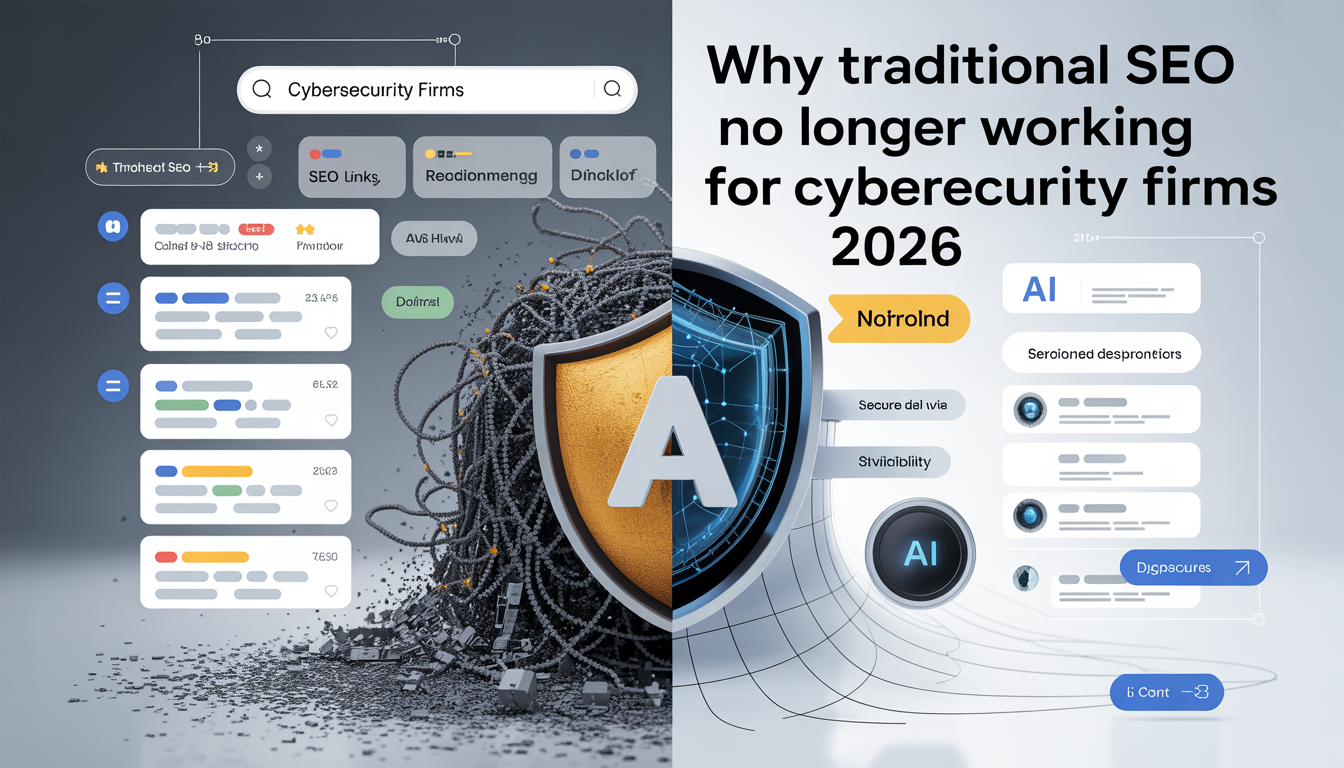
Traditional SEO is no longer producing reliable leads for cybersecurity firms because the search environment itself has fundamentally changed.
AI Overviews, ChatGPT, Perplexity, and Claude now answer most informational queries directly, eliminating the click that once delivered traffic to ranked pages.
Buyers researching cybersecurity providers increasingly ask AI assistants conversational questions like “who is the best MSSP for a 200 person financial services firm” and receive synthesized recommendations without ever visiting Google.
Cybersecurity firms that continue investing only in keyword rankings, technical SEO, and link building are watching impressions rise while qualified leads decline.
The strategy that built MSP and security firm pipelines from 2010 to 2022 is now structurally obsolete for high intent informational queries, and the gap between ranking and revenue continues to widen.
The Hidden Crisis Inside Cybersecurity Marketing
For more than a decade, cybersecurity firms followed a predictable playbook. Build a content hub. Target keywords. Earn backlinks. Watch rankings climb—and watch the lead generation system
That playbook is breaking. Many MSPs, MSSPs, vCISO firms, and IT services providers report a frustrating pattern: organic impressions are stable or growing, but the form fills, demo bookings, and discovery calls have flattened or declined. The disconnect is not a tracking problem. It is a structural shift in how buyers find cybersecurity providers.
Organic impressions may rise, but results don’t. Rising costs across modern digital marketing strategy are not translating into pipeline growth.
Why This Hits Cybersecurity Especially Hard
Cybersecurity sits at the intersection of every condition that makes traditional SEO underperform in the AI era.
It’s a deeply sales performance dependent process where buyers rely on confidence, not just visibility.
The category is uniquely vulnerable because:
- Buyers ask complex, contextual questions that map perfectly to conversational AI rather than keyword search.
- Technical jargon and acronyms (SIEM, SOAR, XDR, EDR, MDR, ZTNA) are exactly the kind of terms LLMs are trained to define and disambiguate.
- The buying journey is long and trust based, meaning prospects do extensive pre vendor research that increasingly happens inside AI assistants.
- Decision makers are time constrained executives who prefer one synthesized answer over ten links to evaluate.
- The cost of choosing the wrong provider is severe, so buyers gravitate toward AI tools that summarize reputations, capabilities, and risks across many sources at once.
When a CFO asks ChatGPT “what should we look for in an MDR provider for a regional bank under 500 employees,” the answer they receive shapes the entire shortlist. If your firm is not part of that synthesis, your ranking on Google for “MDR services” no longer matters in that decision.
The Decline of Keyword Based Search
Keyword search is not dead, but its share of high value cybersecurity queries is shrinking fast. Three patterns explain why.
First, buyers have stopped translating their questions into keyword shorthand. A CIO no longer types “best MSSP enterprise” into Google. They type “we run mostly Azure with some on prem legacy systems and need 24/7 SOC coverage but our internal team is only three people, what should we be looking for in a security partner” into ChatGPT.
Second, the queries that do still hit Google increasingly receive AI Overviews at the top of the results page, pushing traditional listings below the fold. Studies of AI Overview prevalence consistently show high penetration in B2B technology categories, including cybersecurity.
Third, even when traditional results appear, the click rates have collapsed for informational queries. Buyers read the AI summary and move on, often directly to a brand search for one of the firms mentioned in the answer.
And the few brands that appear in answers benefit from compounding visibility—driving long term marketing growth strategy.
Rankings Without Revenue: The New Normal
The painful reality for many cybersecurity marketers is that they have never had better SEO metrics or worse pipeline contribution.
Common symptoms of the new disconnect:
- Top three rankings for category defining keywords with declining click through rates.
- Strong impressions in Google Search Console but stagnant demo requests.
- Traffic that arrives but bounces because it was never high intent in the first place.
- Form fills increasingly dominated by job seekers, students, and competitor research.
- Direct branded traffic rising mysteriously, often because users heard the brand name inside an AI tool and searched it later.
The last point is critical. AI mentions are quietly driving brand searches that show up as “direct” or “organic branded” traffic, masking the true source of acquisition. Without measuring AI visibility, cybersecurity firms cannot see where their best leads are actually originating.
The Rise of Zero Click and AI Generated Answers
Zero click search means the user gets their answer without clicking through to any source. In cybersecurity, zero click outcomes now dominate informational queries because the answers are well suited to synthesis.
Consider these common buyer questions:
- “What is the difference between MDR and XDR?”
- “How much does a SOC as a service typically cost for a mid market company?”
- “What should be included in an incident response retainer?”
- “Is a vCISO worth it for a 150 person SaaS company?”
Five years ago, each of these queries would have driven traffic to a dozen MSP and MSSP blog posts. Today, each receives a clean, synthesized AI answer that quotes two or three sources at most. The traffic that once flowed to ranked pages now flows nowhere visible to traditional analytics.
For cybersecurity firms, this is both a threat and an opportunity. The threat is that informational content traffic is collapsing. The opportunity is that the few sources cited in those AI answers earn outsized influence, often becoming the de facto experts in the buyer’s mind.
Why Paid Search Cannot Fill the Gap
Many cybersecurity firms have responded to declining organic performance by shifting budget to Google Ads, LinkedIn, and intent data platforms. The results are mixed at best.
This is why traditional digital marketing strategy alone is no longer enough.
The challenges with paid acquisition in cybersecurity:
- Cost per click for terms like “managed cybersecurity services” or “SIEM provider” routinely exceeds $30 to $80, with some terms approaching $200.
- Conversion rates from paid traffic are often weak because cybersecurity buyers are deeply skeptical of vendor sourced messaging.
- LinkedIn campaigns increasingly require six figure annual investments to reach meaningful frequency in target accounts.
- Intent data platforms surface accounts that are “in market,” but everyone with a budget is reaching the same accounts at the same time.
- AI driven ad placements compete for attention with AI generated organic answers that often sit above them.
Paid acquisition still has a role, but it cannot replace the trust building function that organic content once played. And it certainly cannot substitute for being recommended by an AI assistant.
The Trust Problem: Why Buyers Believe AI Over Vendors
Cybersecurity has always been a trust based purchase. Buyers do not just want a capable provider; they want a provider they can trust with the keys to the kingdom. That trust requirement is precisely why AI search is reshaping the category so quickly.
That shift directly impacts sales performance.
Buyers trust AI answers in cybersecurity research because:
- AI synthesizes across many sources, reducing reliance on any single vendor’s marketing claims.
- AI cites sources, allowing buyers to verify the most important claims.
- AI surfaces patterns across reviews, news coverage, analyst reports, and technical documentation that no buyer could compile manually.
- AI delivers answers in minutes, compressing what used to be weeks of research.
Vendor controlled channels (websites, sales decks, gated whitepapers) carry inherent skepticism. AI mediated discovery feels closer to a referral from a knowledgeable peer. That perception, fair or not, is shaping buying behavior.
What Cybersecurity Firms Must Do Now
The strategic response is not to abandon SEO. It is to reframe content and authority work around being cited by AI rather than ranking on Google.
Immediate actions for cybersecurity marketers:
- Audit existing top ranking content and rewrite each section to lead with a direct, quotable answer.
- Add structured FAQ blocks to every service page, addressing the questions buyers actually ask AI.
- Build out entity rich pages about your methodologies, frameworks, certifications, and named experts.
- Pursue mentions in industry publications, analyst databases, and reputable cybersecurity media that LLMs treat as authoritative.
- Publish original research, threat reports, or benchmark data that other sources will cite.
- Track AI visibility separately from rankings, monitoring how your brand appears in ChatGPT, Perplexity, Claude, and Google AI Overviews.
The firms that move first will become the default recommendations within their niche. The firms that wait will find that AI has settled on a small set of preferred sources, and dislodging those incumbents requires far more effort than earning the position originally would have.
Traditional SEO must now be combined with Generative Engine Optimization (GEO) and supported by a structured AI SEO strategy to maintain visibility.
This shift is essential to increase business performance in AI driven search environments.
The Window Is Closing
LLMs develop preferences. Once a model regularly draws from a specific source for a given topic, that source compounds influence. Buyers who hear the same firm recommended across multiple AI tools begin to treat that firm as the category standard, regardless of the underlying merit.
For cybersecurity firms, this means the next 12 to 24 months are unusually consequential. The brands that establish AI visibility now will benefit for years. The brands that wait for “the dust to settle” will discover that the dust settles into a layer that buries them.
FAQ
Is SEO dead for cybersecurity firms?
No, but its role has changed. Traditional ranking optimization still matters, but it must be combined with GEO and AEO to maintain visibility in AI driven search.
Why are my cybersecurity blog posts getting traffic but no leads?
Often because the traffic is low intent, or because high intent buyers are reading AI summaries and converting on branded searches that look like direct traffic.
Should I stop investing in cybersecurity SEO?
No. Reduce investment in low value keyword targeting and reallocate toward AI optimized content, original research, and third party authority building.
How do I know if AI tools are recommending my MSP?
Manually query ChatGPT, Perplexity, Claude, and Google AI Overviews with category questions, or use emerging AI visibility tools that track brand mentions across major engines.
What kind of cybersecurity content does AI cite most?
AI cites content that is structured, factually dense, written by named experts, supported by schema, and reinforced by mentions across high trust third party sources.
Are paid ads still worth it for cybersecurity firms?
Paid ads remain useful for branded defense and specific transactional queries, but they cannot replicate the trust building role that organic content and AI citations now play.
Why is cybersecurity especially affected by AI search?
Because buyers ask complex, contextual questions, the category is jargon heavy, the sales cycle is long and trust based, and decision makers prefer synthesized answers over evaluating ten links.
Do I need to rewrite all my old content?
Not all of it. Focus first on top traffic and high revenue relevance pages, rewriting them to lead with direct answers and adding FAQ schema.
What is zero click search and why does it matter to MSPs?
Zero click search is when a user gets their answer without clicking any source. It matters because most informational MSP and cybersecurity queries now end without a click.
Can a small cybersecurity firm compete with large MSSPs in AI search?
Yes. Small firms can outperform large competitors in niche topics, geographies, or verticals by producing precise, well structured, expert content.
How long does it take to see results from AI focused content?
Typically three to nine months, depending on how often the relevant AI engines refresh retrieval and how mature your existing authority is.
What is the most damaging mistake cybersecurity marketers are making right now?
Continuing to optimize for keywords without measuring AI visibility, which leaves them blind to where their pipeline is actually being shaped.
The brands that establish early visibility gain long term advantage through consistent marketing growth strategy.
Written by Razvan Calarasu: Founder of High 5 Guru, specializing in AI visibility, GEO, and AEO strategies for Digital Marketing firms.
Founder of High 5 Guru
Key Takeaways
- Traditional SEO is no longer reliably producing leads for cybersecurity firms because AI now answers most informational queries directly.
- Buyers increasingly research providers inside ChatGPT, Perplexity, Claude, and Google AI Overviews rather than on Google search results.
- Rankings without revenue is now a common pattern, masking a deeper visibility crisis.
- Paid search cannot replace the trust building role that organic content and AI citations now play.
- Cybersecurity firms must shift toward GEO and AEO to be cited in the AI answers that shape buying decisions.
- Strengthen presence on review platforms to improve local business growth signals